
How to Choose a Donor Car for Your Group B Build
I’m Callum Briggs, from Hereford. Eighteen years in the Group B world as an enthusiast and professional restoration consultant. Over that time, I’ve helped dozens of builders start recreation projects, and watched about half of them waste serious money on the wrong donor car. These mistakes are predictable. They’re almost always avoidable. That’s what I want to cover today.
This isn’t a polished buying guide. It’s closer to a lessons-learned document from years of dealing with the fallout when someone buys the wrong car. I’d rather give you the difficult parts up front than let you discover them after you’ve already wired money to a seller in Turin.
Why Donor Selection Makes or Breaks the Project
People underestimate this step because they’re focused on what the finished car will look like. The donor car doesn’t feel exciting in the same way; it’s just the starting point, right?
Wrong. The donor car determines your build path, your budget exposure, and often whether the project ever gets finished. A bad donor doesn’t just cost you what you paid for it. It costs you six months of remediation work before you can start building what you actually wanted to build. I’ve seen projects abandoned at the midpoint because the donor turned out to be more rotten than it looked, and the owner ran out of money fixing foundation problems.
The right donor car is the one that matches your actual build target. That sounds obvious. But a surprising number of people get to a deposit stage before properly researching what their target Group B car was actually based on structurally.
Platform Reality Check: What Each Build Actually Needs
The most important thing I tell every client before we start: Group B rally cars were not modified road cars. They were purpose-built machines. Some share a lineage with production vehicles. Many don’t. You need to know the difference before you start searching.
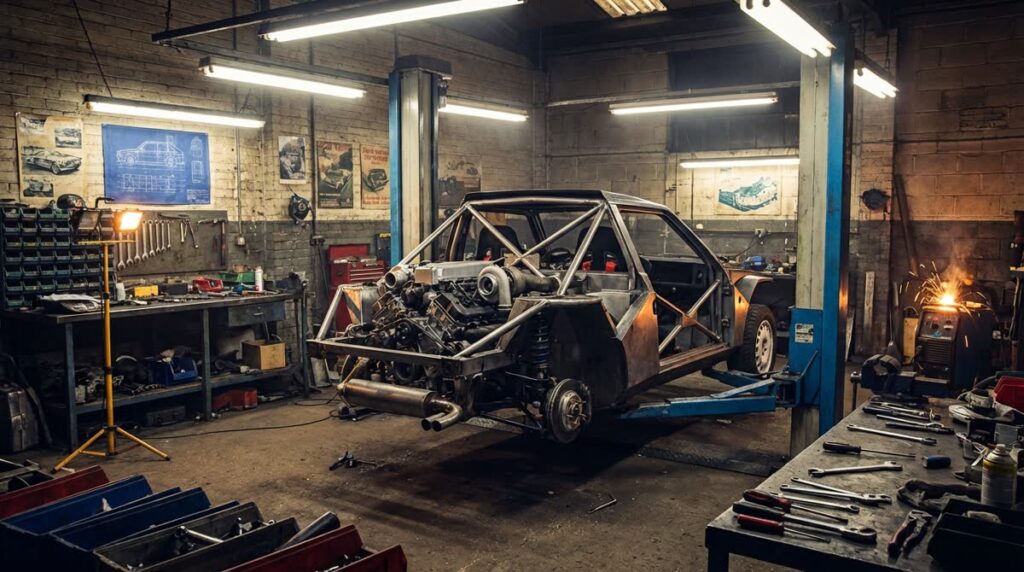
Lancia Delta S4: I’ll start here because it generates the most confusion. The S4 (1985-1986) was built on a purpose-made tubular spaceframe. It shares a name with the road-going Delta and some exterior visual cues, and that’s roughly where the similarity ends. Buying a road-going Lancia Delta as your S4 donor is structurally meaningless. The genuine road-legal S4 Stradales (200 units built to satisfy homologation) are the only production cars with relevant architecture, and those are currently selling for 180,000-250,000 euros. Most S4 recreation projects start from a custom-fabricated chromoly spaceframe rather than any production vehicle. That’s the correct approach.
Lancia 037: The 037 used fiberglass body panels over a steel spaceframe, with suspension geometry drawn from the Lancia Beta Montecarlo/Scorpion. So the Beta Montecarlo (1975-1982) is relevant: it can donate the 1.8L twin-cam engine, the 5-speed gearbox, and inform the suspension pickup geometry. But “providing reference” is not the same as “bolt-on compatibility.” The majority of suspension components still need to be custom-fabricated. A Montecarlo is a useful starting point for a 037 build, not a shortcut through it.
Ford RS200: No direct road car equivalent. The RS200 was purpose-built from scratch. Some builders reference the Mk3 Escort or Sierra floor plan for packaging, and the Sierra Cosworth T5 gearbox is commonly adapted for the drivetrain. But this is a heavily custom project from day one. There’s no production Ford that gives you a meaningful structural head start.
Audi Quattro S1: This is the one case where a production donor makes obvious sense. The S1 Evo 2 (1985 specification) was developed from the Ur-Quattro monocoque: same 5-cylinder turbocharged engine family, same quattro AWD architecture, same basic body structure. A solid Ur-Quattro (1980-1991) in driver-quality condition runs $15,000-35,000 in the US as of 2024. That’s a meaningful structural and mechanical starting point, and money spent on a good Ur-Quattro is money well spent. Even so, expect extensive body reinforcement, wide-body conversion, and powertrain upgrades. A complete S1 recreation still costs $80,000-140,000 beyond the donor.
Renault 5 Turbo: The road-going R5 Turbo (1980-1984) used a mid-mounted 1.4L turbocharged engine in a layout very similar to what Group B rules formalized. So the road car is the natural donor: same layout, same drivetrain family. Solid examples in Europe run 25,000-65,000 euros. In the US, the 25-year import rule has made these available since around 2005. Of the major Group B platforms, this is the one where a direct road-car donor makes the most structural sense.
MG Metro 6R4: The 6R4 used a mid-mounted 3.0L V6, the V64V engine developed from BL’s O-series. A recreation costs roughly 90,000-150,000 pounds. The Metro shell itself is nearly worthless (200-500 pounds) because the entire bodywork gets replaced with composites anyway. The budget constraint is always the engine: a rebuilt V64V unit runs 15,000-35,000 pounds.
Chassis Assessment: Where Cheap Cars Cost You the Most
Once you know what platform you actually need, the next question is condition. This is where the “bargain” donors destroy budgets.
Sill rot on Italian classics. On a Lancia Beta Montecarlo or Fiat 131 Abarth, the sill sections are the first to go. A full sill replacement at a specialist in Italy runs 1,500-3,500 euros. If the inner sill is also compromised, structural rigidity is gone. That’s a build-stopper unless you were planning to strip the monocoque entirely and fabricate a full spaceframe. Know which path you’re on before you negotiate.
Floorpan rust on the Beta Montecarlo. Tap the floor with a hammer. Hollow sounds mean the rust is coming from inside. A full floorpan replacement runs 800-2,000 euros in panels, plus 30-40 hours of professional labor. A “cheap” car at 3,000 euros with a rotten floor often ends up costing more than a 12,000 euro solid example from Italy once you’ve done the structural work.
Firewall condition. For mid-engine conversions such as the 037 recreation, the firewall gets cut anyway. Firewall rot doesn’t matter if you’re replacing it. What matters are the subframe mounting points and door pillar structure: these take the loads and are expensive to rebuild if compromised.
Suspension pickup points. On an Ur-Quattro, the front MacPherson strut towers and rear trailing arm mounts must be solid. Corroded pickup points require welding in new metal and professional structural assessment. Add 2,000-4,000 euros to your budget if these need attention.
VIN stamps. On Italian cars, the VIN appears in multiple locations: the firewall stamp, the dashboard plate, and on a Lancia Beta, the B-pillar. All VIN locations must be intact to prove the car’s identity. Missing or altered stamps complicate title transfer and future registration. Don’t accept a car where any VIN location has been altered or removed.
Verifying the Donor Car’s Background
This step gets skipped more often than any other, and it’s responsible for more mid-build disasters than chassis rust.
Competition cars change hands constantly, sometimes through proper transactions, sometimes through paddock handshake deals. Informal sales don’t discharge liens. If a previous owner used the car as collateral and never paid off the loan, that lien follows the VIN. When you try to retitle the car in your name, the DMV won’t process it until the lien is discharged. I’ve watched builders discover this problem six months into a build, with the car already stripped down to a rolling shell and the lien-holder demanding payment or repossession.
Before committing to any donor, run a full vehicle history check to confirm clean title status, verify no hidden liens are attached to the chassis, and check for any undisclosed accident or damage records. For cars coming out of Copart or IAAI auctions, this is mandatory: some competition cars have gone through multiple salvage cycles, with each incident adding to the record. A car that’s been written off twice costs you differently than one that’s been written off once, and you need to know before you bid.
For European cars being imported to the US: when a classic arrives without US documentation, it typically receives a Manufacturer’s Certificate of Origin (MCO) and the owner applies for a state title. Texas, Montana, and Vermont are more accommodating than most states for titling imported vehicles without existing US paperwork. The Vermont method (Form VD-119, no title required for vehicles over 15 years old) is commonly used for paddock cars with no documentation. Add $500-1,500 to budget for title recovery assistance if needed.
Budget Planning: Real Numbers
People consistently underestimate this. I tell every client to double their initial budget estimate and expect to land somewhere near reality. Group B recreation projects run into unexpected costs constantly: sourcing delays, fabrication revisions, parts that turn out to be unavailable or more expensive than anticipated.
037 recreation (UK, 2024). A full period-correct recreation using proper tubular spaceframe, Montecarlo-derived suspension geometry, and a 2.0L supercharged/turbocharged unit runs approximately 120,000-180,000 pounds in parts and specialist labor. That excludes the donor car.
Audi Quattro S1 recreation (US, 2024). Starting from a $20,000 Ur-Quattro donor, a full S1 Evo 2 specification recreation costs $80,000-140,000 in parts and labor. The wide-body Evo 2 bodywork alone runs $8,000-15,000 from European specialists.
6R4 recreation (UK, 2024). 90,000-150,000 pounds, with the V64V engine as the primary cost driver at 15,000-35,000 pounds for a rebuilt unit.
European import costs. Shipping a donor from Italy or the UK to a US East Coast port runs $1,200-2,000 via roll-on/roll-off (RoRo). US import duties on vehicles over 25 years old are 0-2.5%. Total import overhead is typically $2,000-4,500 depending on origin and destination port.
The cheap donor is almost never cheap. A 3,000 euro Montecarlo with major rust requires 8,000-12,000 euros in structural remediation before the build can proceed. A solid 12,000 euro example saves money overall. The donor car is not where to economize.
Where to Actually Find Donor Cars
Italian specialist dealers. AutoScout24 (IT), Subito.it, and specialist dealers in Milan and Turin are the primary market for Lancia classics in Europe. Condition photographs are often cosmetic; structural issues rarely show in listings.
British classic car auctions. Historics, Bonhams, and H&H Classics regularly list 1970s-80s Italian sports cars. Catalogued auction lots typically include some provenance documentation. Buyer’s premium runs 12-18% on top of hammer price.
Club and community private sales. The Lancia Motor Club UK and Beta Owners Club are better sources for well-documented examples than anonymous private listings. Prices are higher, but documented history files reduce risk considerably.
eBay Motors international listings. Photographs show cosmetic condition, not structural condition. Always hire an independent inspector in the seller’s location before wiring money internationally. Remote PPI cost runs $400-800 including a detailed report.
Copart and IAAI salvage auctions. Competition cars occasionally appear here after race accidents or team dissolutions. Condition varies from “minor damage, excellent mechanical” to “complete write-off.” The VIN history check is non-negotiable before bidding.
Pre-purchase inspection. For any donor car over $10,000, hire a specialist mechanic for a PPI before committing. Cost is $200-500 in the US, 150-400 pounds in the UK. For a car going into a 100,000+ pound build project, this is the smallest line item in the whole job.
Borescope inspection. If you can’t start the engine during inspection, a borescope check ($50-150 at a shop) shows cylinder wall condition without disassembly. Worth doing on any candidate over $15,000.
The Decision
The right donor car for a Group B build is the one that matches your structural needs, has verifiable clean documentation, and doesn’t have hidden damage that will drain your budget before the real build begins. That’s it. Everything else, price, cosmetics, what it looks like on paper, is secondary to those three criteria.
I’ve watched too many projects stall or die because someone bought on enthusiasm rather than due diligence. The cars that make it to completion, the ones that actually drive, that actually look right, that actually get used, start with the right foundation. Take the time to find it. The build will go better for it in every phase that follows.